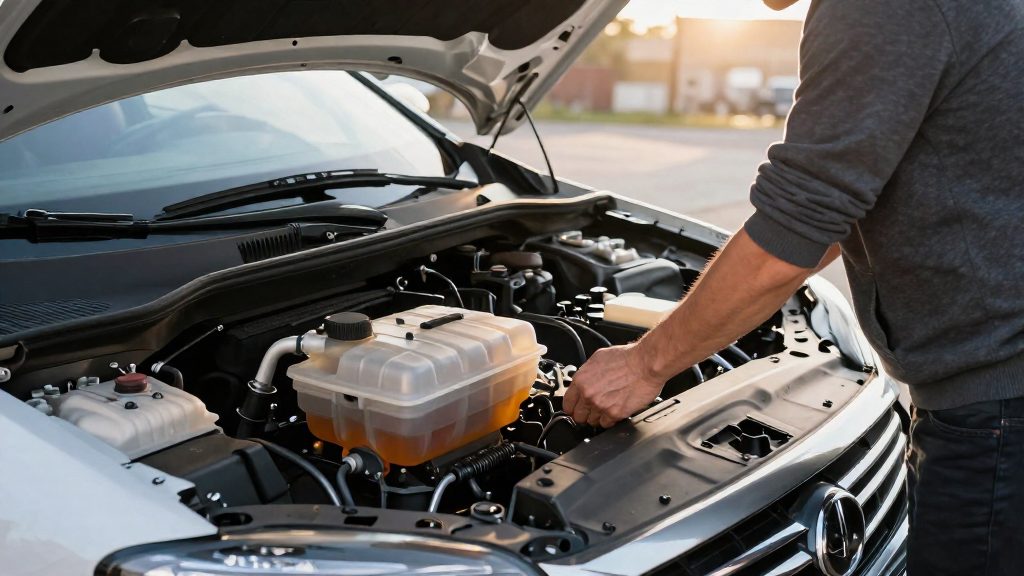
There is no single brake fluid change interval that applies to every car in Canada. The official sources consulted do not set a mandatory replacement interval for passenger vehicles, so the schedule in your owner’s manual is the reference. In the manuals reviewed for this article, the interval is given in years rather than kilometres: one Canadian owner’s manual calls for replacement every 3 years, while a 2026 owner’s manual requires replacement annually only under severe use or in extremely humid climates. Check your own manual before relying on any figure.
How often should brake fluid be changed?
The answer comes from the manufacturer. Manuals express brake fluid replacement in years, in kilometres, or in both, and some place it in the main maintenance chart while others put it in a footnote or remark that depends on how the car is used. Read the whole schedule, including the notes, before deciding when your car is due.
If you cannot find any brake fluid entry in the manual, the official sources consulted do not supply a default. In that case, contact a dealer or a qualified technician, give them your vehicle identification number, and ask for the manufacturer’s written recommendation before you wait any longer.
Why does brake fluid need replacing?
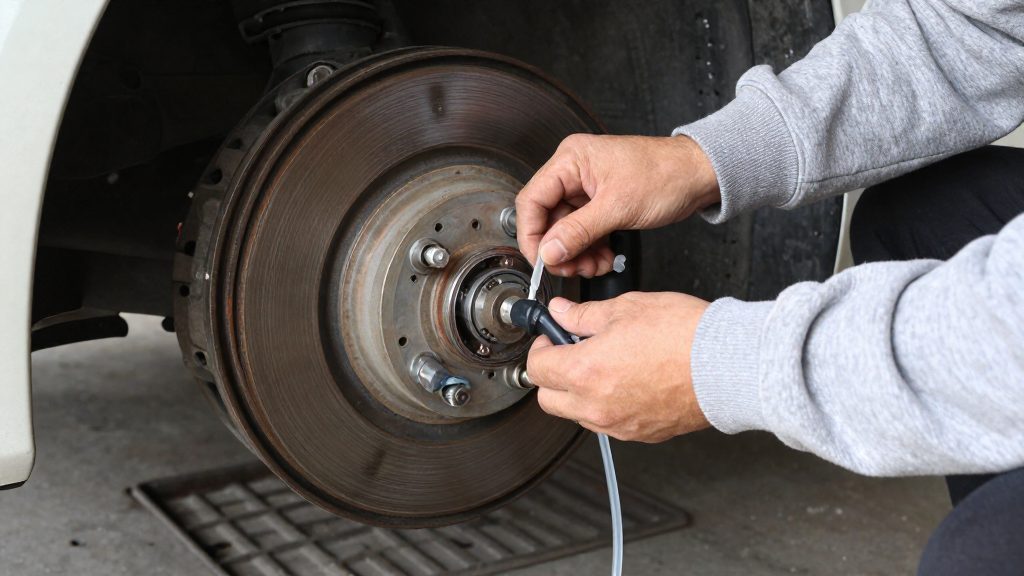
Brake fluid is hygroscopic, meaning it absorbs water from the air over time. Moisture can enter through the reservoir cap and through the brake hoses, even when the car is parked. The water itself is only part of the problem. Water lowers the boiling point of the fluid. During heavy or repeated braking, the fluid near the hot calipers and discs can reach a temperature at which vapour bubbles form. Bubbles compress when you press the pedal, so the pedal feels soft and braking force drops.
Water also promotes corrosion inside metal parts such as the master cylinder, the wheel cylinders, the calipers and the ABS unit, and it uses up the additives that protect those surfaces. Replacing the fluid removes the accumulated water and restores that protection. A fluid change is therefore preventive maintenance: it keeps the braking system working as designed, rather than repairing a fault that has already appeared.
What do Canadian owner’s manuals say?
Two recent manuals show how the schedule is usually written. A 2018 owner’s manual for a compact crossover states that brake fluid should be replaced every 3 years, independent of the maintenance reminder system. That means a dashboard reminder based on driving distance may never signal brake fluid at all, so the calendar matters.
A 2026 owner’s manual for a compact SUV handles it differently. Its maintenance chart marks brake fluid for replacement at several service points but gives no mileage figure. The only time-based instruction is a remark stating that the fluid should be replaced annually if the brakes are used extensively or the vehicle is operated in extremely humid climates.
To find your own schedule, open the maintenance section of the owner’s manual, or the digital version on the manufacturer’s Canadian website, and look for brake fluid in the schedule table. Then read the notes below the table, because they often hold the conditions that shorten the interval. Keep a record of the date and kilometres at each service so you can compare it with the schedule later. Transport Canada’s recall database lists safety recalls, not routine maintenance, so it will not give you an interval, but it is worth searching for brake-related recalls on your vehicle.
Does driving style or climate change the interval?
Yes, according to the 2026 manual described above. It calls for annual replacement when the brakes are used extensively, with continuous hard driving and mountain driving given as examples, or when the vehicle is operated in extremely humid climates. Long descents in mountain regions and repeated hard stops both load the braking system heavily, so they can bring a car into the severe-use condition. Towing heavy loads is also demanding on brakes, and it is worth checking the manual’s wording to see whether it applies to your use.
The official sources consulted do not define what counts as an extremely humid climate, and the manual does not give a threshold. If you live in a damp coastal area or drive in a wet region, treat the humidity condition as a reason to follow the shorter, annual schedule only if your manual’s wording applies to your location. Where the manual is unclear, ask the manufacturer or a qualified technician rather than guessing.
When should you change it sooner?
Certain signs mean you should not wait for the scheduled date. The most important is the brake warning light on the dashboard. A low fluid level can result from a leak or from worn brake pads, and both need inspection. A 2010 Transport Canada recall notice describes the warning lamp as an early indication of fluid loss, which makes it a reason to act, not a reminder to top up. If the light comes on while you are driving, pull over safely, stop the car and arrange for it to be towed or checked before continuing.
Other signs are a pedal that feels soft or spongy, a pedal that sinks further than usual before the car slows, longer stopping distances, or a car that pulls to one side when braking. Fluid that looks dark or contains particles suggests the fluid is due, but colour alone is not a reliable test, so do not use it as your only guide.
How is a brake fluid change done safely?
Brake fluid is toxic if swallowed, irritates the eyes and skin, and damages painted surfaces. Keep the container sealed and closed, wipe any spill immediately with water, and wash your hands after handling it. Use only the fluid type named in the owner’s manual. Brake fluids sold for road vehicles are classified as DOT 3, DOT 4 or DOT 5 under the Canadian standard on motor vehicle brake fluids, which Transport Canada bases on the corresponding United States standard. Use a fresh fluid from a newly opened sealed container for each service.
Replacing the fluid means removing the old fluid and bleeding the system so that no air remains in the lines, usually in a set sequence described in the manufacturer’s service information. Air in the lines produces the same soft pedal as moisture-related boiling, so the procedure must be done properly. A 2010 Transport Canada recall notice describes a case in which a master cylinder seal could leak after a low-polymer fluid was used and the system was bled manually. The lesson is that both the fluid and the procedure matter.
If you are not trained in brake work, have a qualified technician perform the service. Do not overfill the reservoir, and keep the level between the minimum and maximum marks. After any brake work, test the pedal at low speed in a safe, low-traffic area before driving normally. If the pedal does not feel firm and consistent, do not drive the car until a qualified person has checked it.
What if the service history is unknown?
If you bought a used car and the service record is missing, the official sources consulted do not give a default schedule for that situation. The practical approach is to read the manual’s interval, assume the fluid may already be due, and have a qualified technician inspect the fluid and the system. After the service, record the date and kilometres so that future intervals are easy to track.
Frequently asked questions
Is a brake fluid moisture test useful?
Test strips and electronic testers can estimate water content, but the official sources consulted do not give a Canadian pass or fail threshold. Treat a result as one input and still follow the manual’s schedule.
Can different brake fluid types be mixed?
Use only the type named in the owner’s manual. The official sources consulted do not give a general rule for mixing, so do not mix fluid types unless the manual allows it.
Will a fresh fill turn off the brake warning light?
Not by itself. The light means the fluid level is low or a fault exists, such as a leak, worn pads or a switch problem. Have the system inspected before assuming the problem is solved.