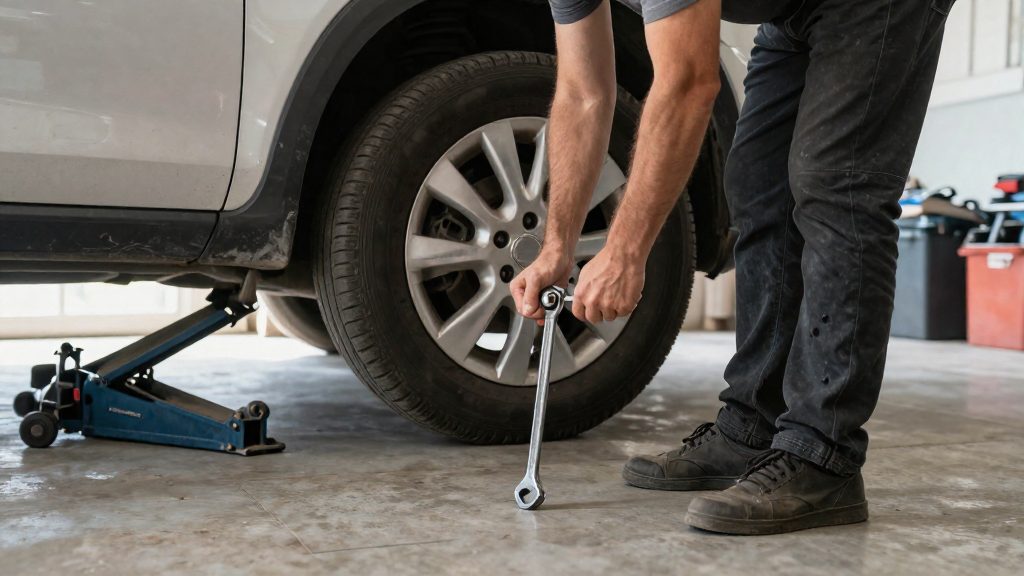
The official sources consulted do not set a tire rotation interval for passenger vehicles in Canada. The schedule that applies to your car is the one in its owner’s manual. When the manual is silent, tire manufacturers’ Canadian care guides generally suggest rotating about every six months or 10,000 km. Treat that figure as a reference point to adjust to how you drive and how your tires wear.
How often should you rotate tires in Canada?
No official source consulted sets a single figure, so the answer comes from two references, in order: the vehicle manufacturer’s recommendation first, then the tire maker’s general guidance. The tire maker’s consumer guide gives the six-month or 10,000 km benchmark. Use it as a checkpoint rather than a deadline. Rough roads, heavy stop-and-go traffic and long highway trips all change how quickly each tire wears, so the condition of the tread can tell you more than the calendar. If one tire is wearing noticeably faster than the others, rotate earlier and have the wheel alignment checked.
What does your owner’s manual say?
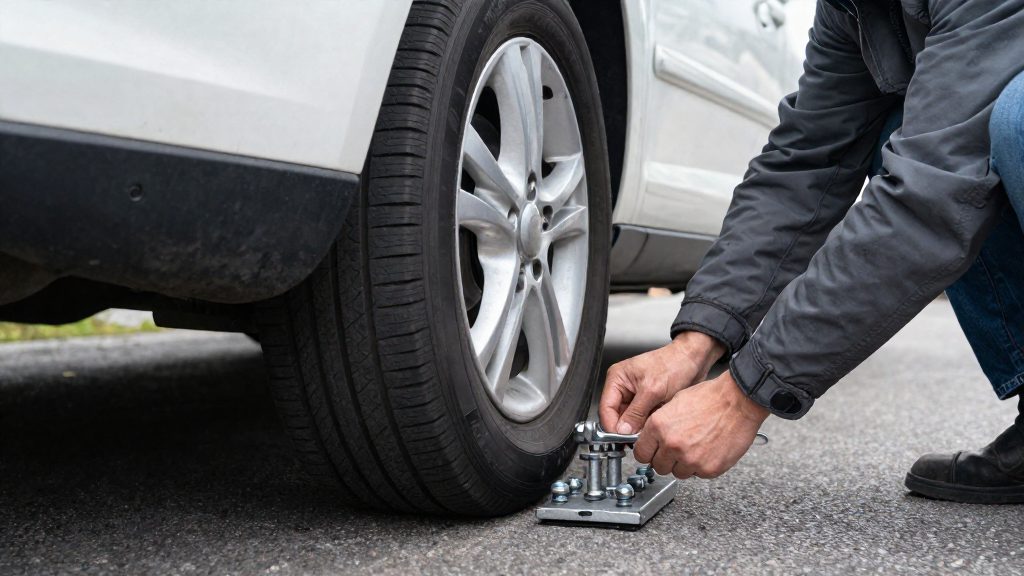
The owner’s manual is the authority for your vehicle. It states the rotation interval and the pattern to use. The pattern depends on the drivetrain (front-wheel drive, rear-wheel drive, four-wheel drive or all-wheel drive) and on whether the tires are directional, meaning they are built to roll in one direction only. The tire maker’s guide follows the same order: the vehicle manufacturer’s recommendation comes first, and the tire maker’s advice is the secondary option.
If you no longer have the printed manual, many manufacturers publish digital owner’s manuals on their Canadian websites. The manual also covers tire pressure, but the recommended pressures are normally printed on the vehicle’s tire information label, and the owner’s manual is the place to look if that label is missing (Transport Canada, 2013).
Why does tire rotation matter?
Front and rear tires rarely wear at the same rate, because each pair handles different loads and does different work. The front pair steers, and on a front-wheel-drive car it also transmits power to the road. Left in one position, a tire develops wear that matches that position, and the set can end up with uneven tread depth long before the tires reach the end of their life.
Rotation moves each tire to a different position so the set wears more evenly. This helps the tires last longer and keeps grip more consistent from one axle to the other. Uneven wear also works as an early warning. A tire that wears faster than its partners often points to a fault in inflation, alignment or balance, and rotation alone will not correct that fault.
When should you check your tires between rotations?
Do the checks at the same time as rotation, and measure pressure only when the tires are cold. Transport Canada advises measuring pressure when the tires are cold and not forgetting the spare. In its guidance, a vehicle counts as cold when it has been stationary for at least three hours or has not been driven more than 2 km (Transport Canada, 2013).
A complete check covers four points. First, compare the pressure in each tire, including the spare, with the figure on the tire information label. Second, look at the tread across the full width of each tire, not only the centre, because wear that shows up on one edge is easy to miss in a quick glance. Third, look for cuts, bulges or cracks on the sidewall and tread. Fourth, note any patch that feels rougher than the rest when you run a gloved hand across it. Write down what you find so you can compare it at the next rotation.
Do all-wheel drive and four-wheel drive vehicles need a different schedule?
The official sources consulted do not give a separate interval for all-wheel-drive or four-wheel-drive vehicles, so the owner’s manual remains the reference. The tire maker’s guide lists four-wheel drive as its own pattern category, which signals that the rotation pattern differs from the front-wheel and rear-wheel layouts. Do not assume that an all-wheel-drive vehicle follows the same rule as a two-wheel-drive car.
If the manual specifies a shorter interval, or asks for tires of matching size and tread depth on these systems, follow it. Fitting a single new tire to one axle can create a mismatch that the manual warns about, so check that section before buying one tire. A tire shop can confirm the requirement for your model.
What does uneven wear look like, and what should you do?
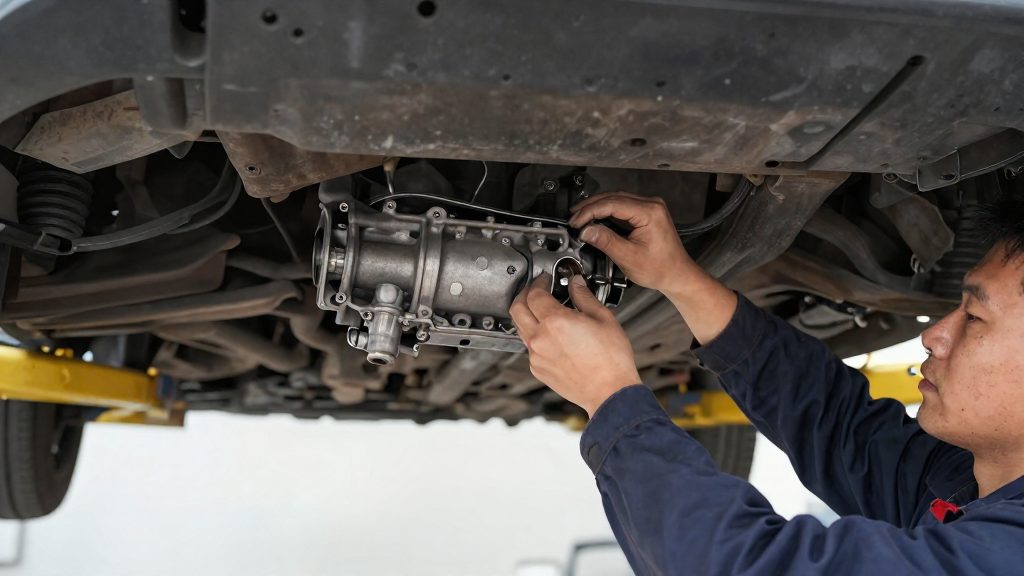
Uneven wear appears in a few recognizable forms. The tread may be worn more on one shoulder than the other, the surface may show a scalloped or cupped pattern, or one area may feel rougher than the rest. Common causes include low inflation, wheel alignment that is out of specification and an imbalance in the wheel and tire assembly. Rotation can even out normal wear, but it cannot repair a fault in the car.
If you see any of these patterns, check the pressure first, then have a technician inspect the alignment and balance before rotating. Rotating a set with an unresolved fault spreads the problem across all four tires instead of solving it. Keep the car in service only while the tires are safe to drive on, and have damaged tires inspected promptly.
Does low mileage change the schedule?
Driving less does not stop tires from wearing or aging. A tire that stays in one position on a short commute can develop uneven wear just as a tire on a long-distance car can, and rubber hardens with time as well as with use. If you drive only a few thousand kilometres a year, rotate at the interval in your manual, whether that interval is set by distance or by time, and rotate sooner if you notice uneven wear.
Low kilometres do not reset the age of the tires. Check the date code on the sidewall and look for cracking in the rubber, especially between the tread blocks, because a tire can become unsafe even when its tread looks adequate.
How do you keep a rotation record?
Write down the date, the odometer reading and the pattern used each time you rotate, and note any tread or pressure findings. A simple log makes it easy to see when the next rotation is due, and it gives a technician the history of the set if a wear problem appears later. Many shops keep records too, so ask for an invoice that shows the rotation and the wheel nut check.
How do you rotate tires safely at home?
If you rotate tires yourself, the safety steps matter as much as the pattern. Work on level, firm ground, set the parking brake, and chock the wheels that stay on the ground. Never rely on a jack alone: place the vehicle on stands rated for its weight before you work under it. Loosen the wheel nuts while the wheel is still on the ground, raise the vehicle, then remove the wheels and fit them to their new positions.
Tighten the wheel nuts in a star or crisscross order, using a torque wrench set to the value in the owner’s manual. Check the nuts again after a short drive, because they can settle. If the wrench is not calibrated, a nut is cross-threaded or you are unsure of the torque value, have a shop complete the job.
Frequently asked questions
Should a full-size spare be included in the rotation?
Check the owner’s manual first. Some spares are temporary and are not meant for regular driving, so they should not be moved into the rotation pattern unless the manual says they can be.
Can directional tires be moved from one side of the car to the other?
Directional tires are built to roll in one direction, so they are normally moved front to rear on the same side of the car. Follow the pattern in your owner’s manual or the tire maker’s guide.
How do I know a tire needs replacing rather than rotating?
Rotation does not restore worn tread. Replace a tire when its tread reaches the wear indicators molded into the grooves, or when it has cuts, cracks or bulges. Have a technician inspect any tire with damage or uneven wear.