What does your owner’s manual say about oil changes?
The right oil change interval is the one your vehicle’s manufacturer sets in the owner’s manual. Manufacturers base their schedules on the engine, the drivetrain, the type of vehicle and the way it is expected to be used. No single federal number applies to every car in the United States, so a mileage figure you read in a forum or a general article is not a substitute for the schedule printed for your vehicle.
Look for a section called scheduled maintenance or maintenance schedule. It usually separates normal use from severe use, and it often gives both a mileage and a time limit. When both appear, the first one reached sets the service date. As an example, one manufacturer’s 2025 US owner’s manual lists engine oil and oil filter replacement every 8,000 miles or 12 months for normal use of a gasoline 3.8-liter direct-injection engine, and every 5,000 miles or 6 months for severe use. Those figures belong to that engine and that model year. Your own engine may differ.

Why the old 3,000-mile habit is not a reliable guide
Many drivers still follow a fixed rule of thumb. The problem is that it ignores the engine your car has, the oil it requires and how you drive. A manufacturer may specify a longer interval for one engine and a shorter one for another, even within the same model line. Use the rule of thumb only if it matches the schedule in your manual.
Normal versus severe service
The manual defines severe use with a list of conditions. In the 2025 US manual cited above, they include:
- Short trips of less than 5 miles in normal temperatures, or less than 10 miles in freezing temperatures
- Extended idling or long periods of low-speed driving
- Driving on rough, dusty, muddy, unpaved, gravel or salted roads
- Driving in areas where salt or other corrosive materials are used, or in very cold weather
- Heavy traffic or frequent stop-and-go driving
- Repeated driving on steep uphill, downhill or mountain roads
- Towing, camping, or carrying loads on the roof
- Commercial use, such as patrol, taxi or other work driving
- Frequent high-speed driving, or frequent rapid acceleration and braking
Another manufacturer’s US manual states the rule in plain terms: follow the normal schedule only if the vehicle is usually operated where none of these conditions apply. If one of them describes most of your driving, use the severe schedule. Be honest about this. A daily commute with long idling and short trips is a common case, even if the trips feel ordinary.
The same manual also says that if the recommended engine oil specification is not used, the oil should be changed on the severe-conditions schedule. The specification, usually a viscosity grade and a standard code, is printed in the manual and often on the oil filler cap. Use it when you buy oil.
How the oil-life monitor fits in
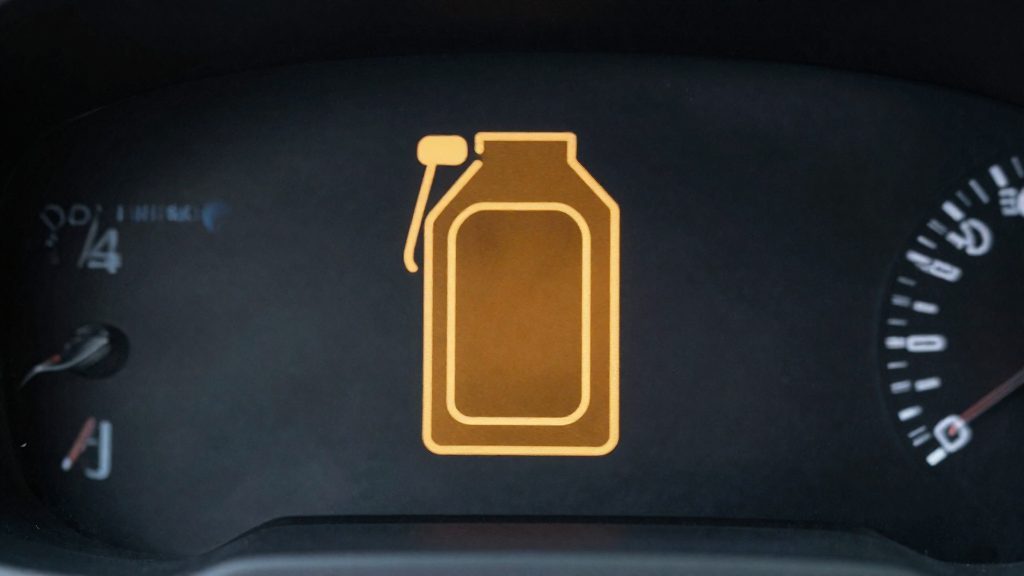
Many newer vehicles estimate remaining oil life from your driving history instead of counting only miles. The result appears on the instrument cluster as a percentage or a reminder. The reminder can come before the normal interval if driving is hard on the oil, so a light that appears early is not a fault. It means the system has detected more wear than expected.
The monitor has two limits. First, it works only when the recommended engine oil is used. Second, it must be reset after each oil change. The manufacturer’s manual says to always reset the remaining engine oil life whenever the engine oil is changed. If you skip the reset, the next reading will be wrong. The reset is usually made from the instrument cluster or infotainment menu, and the exact steps are in your manual. Do not reset it without changing the oil, because the reading would then be false.
Dashboard warning lights: reminder or emergency?
An oil-change reminder is a maintenance message. It means service is due, so schedule it soon and keep driving normally.
An oil pressure warning is different. It means the engine may not be receiving enough lubrication, and continued driving can cause serious and costly engine damage. If the light comes on while you are driving, find a safe place to stop as soon as you can, switch off the engine, and follow the steps in your manual. When the engine has cooled and is off, check the oil level with the dipstick. If the level is low, add the specified oil. If the level is correct, or the light stays on after you add oil, do not restart the engine to drive further. Arrange a tow to a qualified service center.
Where to find your schedule and act safely
Your owner’s manual is the authority, and it may be in the glove box or available as a digital copy. If you no longer have the printed manual, most manufacturers post owner’s manuals online, organized by model and model year. Search the manufacturer’s site with your vehicle’s exact model and year, and check the maintenance section for your engine.
Before you rely on a schedule, confirm three things: the engine in your vehicle, the model year, and the conditions you drive in. Then write down the date and mileage of every oil change, and the date you reset the oil-life monitor. Those records make it easy to see when service is next due, and they help if a warranty question comes up later.
Finally, keep your manual with the vehicle. When you sell or hand over the car, leave the manual and the maintenance records with it so the next owner can follow the same schedule.
Frequently asked questions
What if I have lost my owner’s manual?
Check the manufacturer’s website for a digital copy by model and model year. You can also ask a dealer’s service department whether they can provide the maintenance schedule for your vehicle.
Should the oil filter be changed at the same time as the oil?
Many schedules list the engine oil and oil filter together. Check your manual’s table to see whether the filter is included in the same service.
Does an older or high-mileage vehicle follow a different schedule?
Some manuals switch to a different schedule after a set age or mileage. Look for that condition in the maintenance section of your manual and follow it if it applies to you.