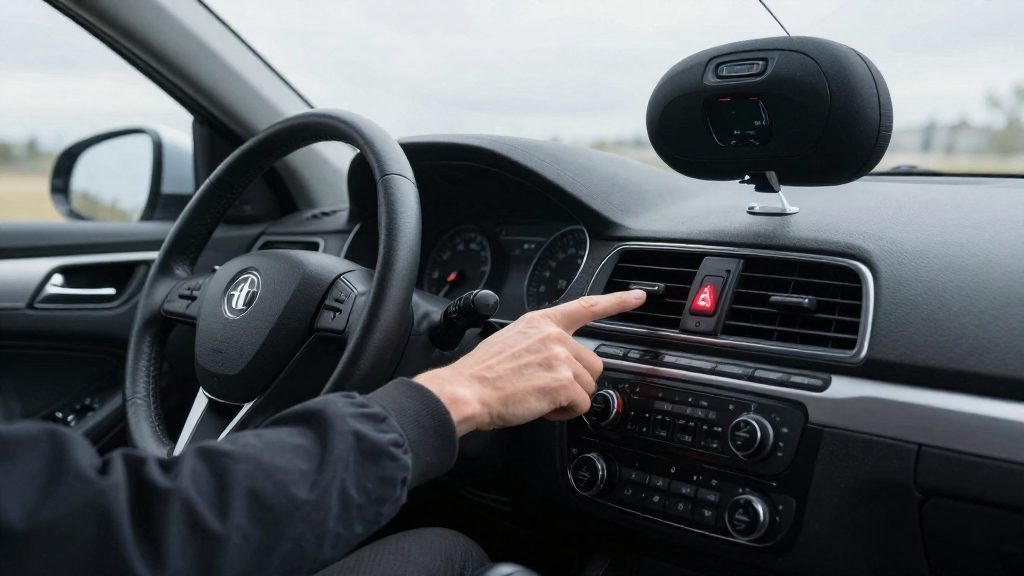
What the airbag warning light means
The airbag warning light tells you that the airbag system has a fault. It is usually labeled “AIR BAG” or shows a seated figure with an airbag in front of it. The system includes the crash sensors, the control module, the inflators that fire the airbags, the wiring and connectors, and the clockspring in the steering column that carries the signal to the driver’s airbag. When the light is on, one or more airbags may not deploy in a crash.
In the United States, the federal occupant protection standard, FMVSS No. 208, requires vehicles with airbags to have a monitoring system with a readiness indicator. The indicator must monitor its own readiness and must be clearly visible from the driver’s seat. The standard does not list every fault that turns the light on, so your owner’s manual is the place to confirm what your vehicle’s light covers.
Why the light stays on, blinks, or does not come on
When you turn the ignition on, the light should come on for a few seconds as a self-check and then go out. That is the normal sequence. Treat the following as a fault: the light stays on after start-up, it never lights at all, or it blinks in a way your manual does not describe. Blink patterns differ between manufacturers, so check the manual for your vehicle rather than relying on a general guide.
Common causes include a faulty crash sensor, a problem in the control module, a damaged or corroded connector, a broken wire, a worn clockspring, or a fault in an inflator. A workshop reads the stored fault codes with a diagnostic scan tool to find the responsible part. The light alone does not tell you which component failed, so do not replace parts based on a guess.
One point often confuses owners. Many vehicles have a passenger airbag on/off switch. Where one indicator serves both the driver’s airbag and the passenger switch, the standard says it must not light solely because the passenger airbag was turned off with that switch. If the main airbag light comes on only when you deactivate the passenger airbag, have it checked. A separate passenger “airbag off” indicator is a different case and is normal when it reflects the switch position.
Is it safe to drive with the airbag light on?
Driving with the light on is often possible for a short trip, but it is not a warning to ignore. The main risk is that the airbags may not inflate in a crash. Seat belts still latch and work, and they remain your main protection, so buckle every occupant every time and follow the manual’s guidance on child restraints and seat positions.
If the light is on, keep trips short and avoid long highway drives until a qualified shop has checked the system. Stop and get help at once if the airbag light comes on together with a brake, steering, or engine warning light, or if you notice smoke, a burning smell, or an unusual noise from the dashboard or steering column.
Do not try to repair the system yourself. Do not probe wires under the seats or near the steering column, do not install accessories near airbag modules, and do not place objects on the dashboard above the passenger airbag. Airbag components are designed to fire with force, so work on them should be done by a technician who follows the manufacturer’s procedures.
Check for airbag recalls with your VIN
The National Highway Traffic Safety Administration (NHTSA) runs the official recall lookup at nhtsa.gov/recalls. You can search by license plate or by the 17-character vehicle identification number (VIN). The VIN is printed on your registration documents and on the vehicle itself. Enter it and read every open recall listed, since airbag recalls are common among them.
Recall repairs are free at an authorized dealer. Check more than once, not only at the first sign of trouble, because a recall can be issued after your last check and it may not appear on the NHTSA site the day it is announced. If you are buying a used vehicle, run the VIN lookup before you pay. An open recall on that VIN still needs to be repaired by a dealer, and you should ask the seller for any repair records.
Older inflator recalls and do-not-drive warnings
Some older airbag inflators have a known defect: under certain conditions they can rupture when the airbag fires, which can send debris into the cabin. These problems are covered by large recalls that involve several manufacturers. NHTSA keeps a public Do Not Drive list of vehicles with unrepaired inflators.
If your VIN appears on that list, or your recall lookup shows an open inflator recall, contact an authorized dealer right away and follow the instructions in the notice. When a warning tells you not to drive the vehicle, stop driving it. Arrange a tow or a dealer appointment instead. The repair is free, and waiting only leaves the risk in place.
What to expect at the repair shop
Before the appointment, write down when the light appeared, whether it came on at start-up, whether it comes and goes, and whether it started after a repair near the steering wheel, seats, or dashboard. Mention any recent collision, even a minor one. These details help the technician narrow the search.
At the shop, ask the technician to read the stored codes, inspect the wiring and connectors, and confirm the fault before replacing parts. Ask them to check open recalls for your VIN before quoting repairs, because an airbag recall may cover the work at no charge. Airbag repair is specialist work, so ask whether the shop has the tools and training for your make and model.
After the repair, the light should run through its normal start-up check and go out. Ask for a written record of the codes read, the parts replaced, and any recall numbers applied, and keep it with your vehicle papers.
When to have the system inspected
Have the system checked as soon as the light stays on, fails to come on at start-up, or blinks. Do not wait for your next routine service. Also have it checked after any collision that deployed an airbag, and after work on the steering wheel, seats, dashboard, or wiring near the airbags.
After an airbag deploys, the modules and related parts are normally replaced rather than reused. Your manufacturer’s service documentation lists the exact parts and checks for your model. Ask the shop to follow that documentation and to confirm in writing that the system was checked after the repair.
Frequently asked questions
Can I reset the airbag light myself?
You can clear stored codes with a scan tool, but that does not repair the fault. If the underlying problem remains, the light usually returns, and clearing it can hide a real problem. Have a shop find the cause first.
Is it safe to disconnect the battery to reset the light?
Do not treat battery disconnection as a reset method. Airbag systems often need a specific waiting period and procedure, and the fault may stay stored. Follow your manufacturer’s instructions or ask a qualified technician.
Can I check a used car’s VIN before buying it?
Yes. The NHTSA recall lookup works for any vehicle with a valid VIN, regardless of who owns it. A recall may not be listed yet, so also ask the seller for repair and recall paperwork.