Before you buy a used car in Canada, check it for open safety recalls, because a required repair may still be waiting on that vehicle. Transport Canada’s Road Safety Recalls Database covers recalls back to the 1970 model year, but it lists recalls for a make, model and year rather than for one car. To confirm whether a specific vehicle still needs a repair, you need its 17-digit vehicle identification number (VIN) and a check with the manufacturer or an authorized dealer. Make this check before you pay, not after you drive the car home.
Why check for recalls before buying a used car?
A recall means the manufacturer has identified a safety defect and is offering a correction. Transport Canada (2019) explains that this correction is usually a repair carried out free of charge by the manufacturer. Manitoba’s Consumer Protection Office adds that you should not be charged for recall repairs. The problem is common enough to justify the check: Transport Canada (2025) estimates that roughly one in five vehicles in use on Canadian roads has an unresolved recall issue. A used car may have changed hands several times, and an open recall is easy to miss if nobody checks the record before the sale.
The check protects you in a practical way. An open recall can affect a part of the car that you rely on every day, and the official correction is free only if the car is taken to be repaired. Finding out before the purchase lets you ask for the repair to be done first, instead of arranging it yourself after you have paid.
Can a used car with an open recall be sold?
Yes, at least in Ontario. The Ontario Motor Vehicle Industry Council (OMVIC) states that dealers and private sellers can legally sell vehicles with outstanding recalls. For that reason, OMVIC stresses that buyers must search for recalls themselves rather than assume the seller has done it. A seller who says the car is clean is describing their own understanding, not a verified result, so the record you check yourself is the one that counts.
The official sources consulted for this article do not set out how this rule applies in other provinces and territories. If you are buying in a different part of Canada, ask your provincial consumer protection office how the sale rules work where you live, and do not assume the Ontario wording applies to you.
How do I check a make, model and year in Transport Canada’s database?
Start with Transport Canada’s Road Safety Recalls Database, the federal search tool for recalls. Enter the make, model and year exactly as they appear on the registration papers, then open each recall listed for that model year. Transport Canada (2019) advises checking this database before buying a used vehicle. Write down the recall number, the part or system involved and the corrective action for each entry, so you can ask the dealer about each one specifically.
Be clear about what this search proves. A model-level search tells you which recalls apply to that model. It does not tell you whether the repair was done on the car in front of you, because two cars of the same model and year can have very different service histories. Only the VIN check answers that question, which is why the database search is a first step rather than the final one.
How do I find the VIN and confirm the repair status?
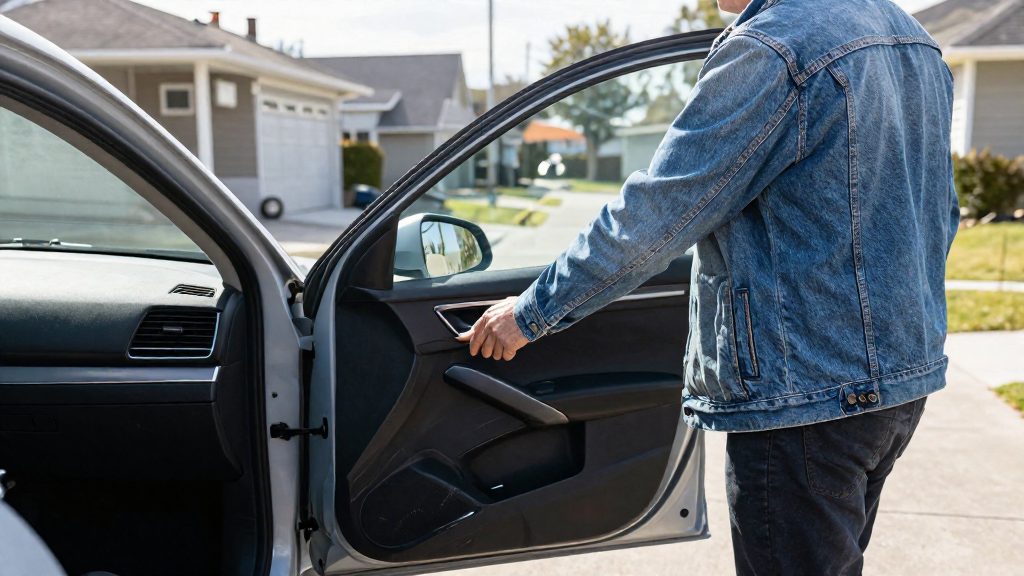
The VIN is a 17-character code. Transport Canada says it is usually located at the lower-left corner of the dashboard, visible through the windshield. It may also be inside the driver’s side door, in the owner’s manual or on the registration papers. Compare the VIN on the vehicle with the VIN on the registration before you go further. If they do not match, stop and ask the seller to explain the difference before you continue the purchase.
Transport Canada (2025) states that designated vehicle manufacturers must provide a VIN lookup tool. The owner enters the 17-digit VIN on the manufacturer’s website and sees which recalls apply to that vehicle. The rules took effect on January 1, 2025, and Transport Canada said all manufacturers must comply by mid-2026. If the manufacturer’s website for that make does not offer the tool, the official sources consulted do not specify an alternative beyond the dealer step described below.
For a definitive answer on repair status, Transport Canada (2019) advises giving the VIN to an authorized dealer. The dealer can consult the manufacturer’s database and tell you whether repairs are still outstanding on that specific car. Ask for the result in writing, listing each recall and its status, and keep it with your sale papers. A verbal reassurance is not enough when the repair is a safety item.
How do I read the results when the database and the VIN check differ?
The model search and the VIN check answer two different questions, so they can show different things without contradicting each other. If the model search lists recalls but the VIN check shows that each repair has been completed, the car is up to date on those recalls. If the VIN check shows that a repair is outstanding, the model search has done its job by alerting you, and the next step is the one described below.
If the VIN lookup returns no result and the dealer cannot confirm the status, treat the car as unverified. Do not rely on the seller’s word, and do not assume that a missing result means there are no recalls. Ask the dealer or the manufacturer to check again with the VIN, and only proceed once you have a clear answer.
When a recall is still open, what should you do?
Transport Canada (2019) advises that if repairs are outstanding on a used vehicle, you should ask the seller to have them carried out before you take possession. In practice, agree in writing that the repair will be completed before you collect the car, and get proof of the completed work from the dealer who performed it. Do not take the car home on the strength of a promise to fix it later.
If the recall notice includes interim instructions, follow them from the day you take the vehicle until the permanent repair is done. Transport Canada (2019) notes that owners should follow any interim instructions in the recall notice. If the seller refuses to arrange the repair, the official sources consulted do not specify your options. Speak to your provincial consumer protection office before you complete the purchase.
How do I keep getting recall notices after buying?
Once the car is yours, Transport Canada (2019) urges you to register the vehicle with the manufacturer, so that future recall notices reach you. If you have not registered it, contact the manufacturer with the VIN. Alternatively, ask the service department of a franchised dealer to update the manufacturer’s database with your details, as OMVIC describes.
Manitoba’s Consumer Protection Office warns that second or third owners may receive a notice late, or that the notice may be sent to a former owner. For that reason, do not rely only on a letter arriving in the mail. Check the recall status yourself with the VIN after the purchase, and keep the proof of completion with your records.
Frequently asked questions
Does a clean recall check mean the car is safe?
Not necessarily. A search only covers recalls that have been issued and recorded for that make, model and year, and it cannot show wear or faults that never led to a recall. A pre-purchase inspection by a qualified mechanic is a sensible addition.
Can I use the US NHTSA database for a Canadian car?
It can be a useful supplement, because some vehicles are sold in both markets and the US database lists US recalls. The official sources consulted do not confirm that its results match Canadian recalls, so Transport Canada and the manufacturer remain the references for a Canadian vehicle.
What if the car is older than the 1970 model year?
The official sources consulted do not specify how to check recalls for vehicles from before the 1970 model year. Ask the manufacturer or a franchised dealer’s service department whether they hold records for that VIN.